EE 642 · Graduate course resource
Data & Digital
Communications
From random processes to reliable digital communication: receiver design, modulation, error performance, synchronization, and coding.
 Browse all lectures
 View course roadmap
The course
About This Course
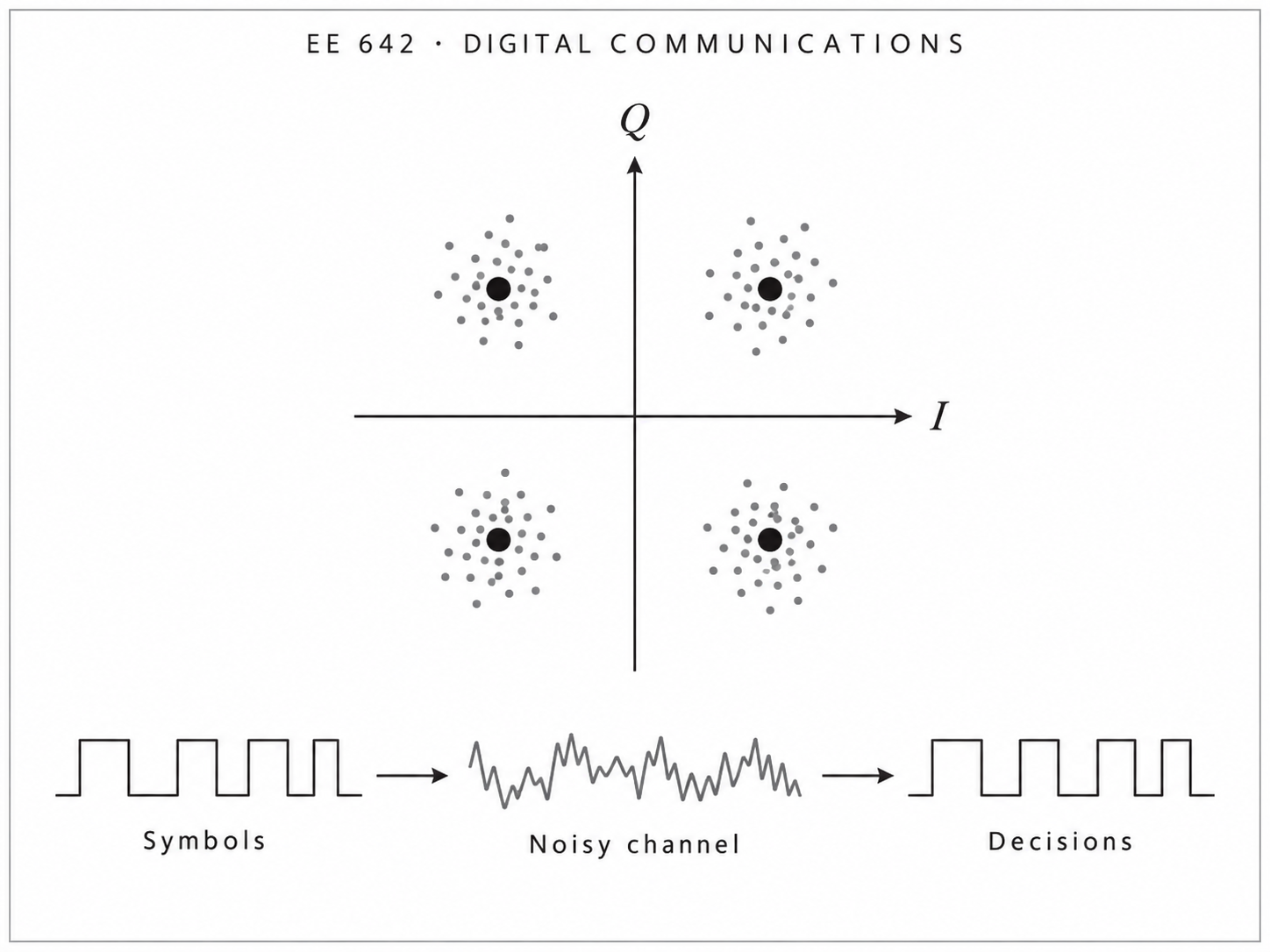
Review random variables, random processes, and linear filtering, then analyze digital communication in noise. Topics include line coding, baseband and M-ary signaling, signal spaces, decision theory, matched filters, bit and symbol error performance, coherent and noncoherent modulation, intersymbol interference, and error-control coding.
The learning path
From probability review
to error control coding.
Follow the original course sequence. Three collections are public; the remaining collections use your existing membership.
Foundations
2 collections
02Linear Systems and Spectra
3 collections
03Baseband Communication
2 collections
04Coherent Communication
4 collections
05Noncoherent Communication
1 collection
06Intersymbol Interference
1 collection
07Synchronization and Fading
2 collections
08Information Theory and Coding
2 collections
The EE 642 lecture library
Find your next lecture.
Search by topic or choose a unit. Each collection includes the original videos in course order.
Course unit
Foundations
Foundations
Random Variable Review
Random variables, distributions, moments, dependence, and Gaussian models.
Foundations
Random Process Review
Process definitions, mean and correlation functions, stationarity, and white noise.
Course unit
Linear Systems and Spectra
Linear Systems and Spectra
Random Processes in Linear Systems · Part 1
Stable linear systems and the mean of their random outputs.
Linear Systems and Spectra
Random Processes in Linear Systems · Part 2
Output correlation, power, discrete-time relationships, and Gaussian inputs.
Linear Systems and Spectra
Frequency Domain Analysis
Power spectral density, filtering, modulation, and bandpass processes.
Course unit
Baseband Communication
Baseband Communication
Baseband Binary Communication · Part 1
Binary signal sets, linear receivers, decision statistics, and error probabilities.
Baseband Communication
Baseband Binary Communication · Part 2
Bayes and minimax decisions, matched filters, and signal space.
Course unit
Coherent Communication
Coherent Communication
Coherent Communication · Part 1
BPSK, ASK, M-ASK, matched filtering, and receiver performance.
Coherent Communication
Coherent Communication · Part 2
M-ary decisions, 4-ASK, Gray coding, and bit error bounds.
Coherent Communication
Coherent Communication · Part 3
Two-dimensional modulation, M-QASK, M-QPSK, and symbol errors.
Coherent Communication
Coherent Communication · Part 4
Orthogonal modulation, MFSK, offset modulation, and bandwidth.
Course unit
Noncoherent Communication
Noncoherent Communication
Noncoherent Communication
Noncoherent receivers, largest-statistic decisions, and BFSK.
Course unit
Intersymbol Interference
Intersymbol Interference
Intersymbol Interference
Dispersion, ISI models, error analysis, and eye diagrams.
Course unit
Synchronization and Fading
Synchronization and Fading
Synchronization and Fading · Part 1
Carrier and symbol timing, PLLs, squaring loops, and Costas loops.
Synchronization and Fading
Synchronization and Fading · Part 2
Frame synchronization, multipath, Rayleigh fading, and error performance.
Course unit
Information Theory and Coding
Information Theory and Coding
Information Theory and Error Control Coding · Part 1
Channel capacity, block coding, Hamming distance, and minimum-distance decoding.
Information Theory and Coding
Information Theory and Error Control Coding · Part 2
Block decoding examples, generator and parity-check matrices, and syndromes.
Practice problems
Apply what
you have learned.
Work through the Spring 2014 Exam 1 problems on the original course site.
Open practice problems